
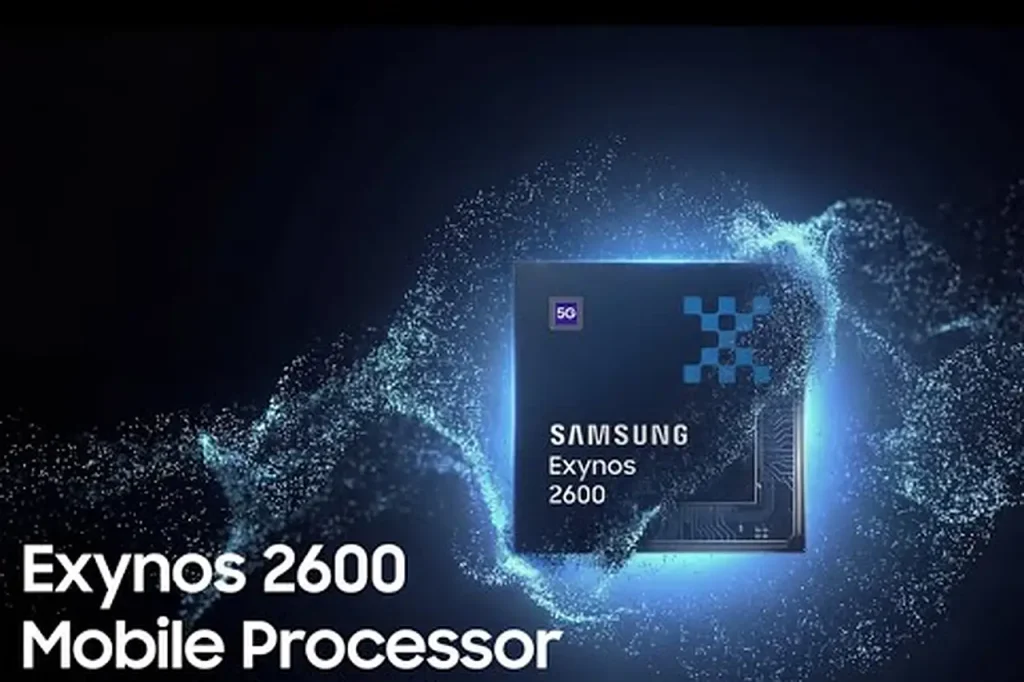
Samsung Unveils Exynos 2600 Mobile Processor with 2nm Process Technology
Samsung Electronics has officially announced the Exynos 2600, its latest mobile application processor featuring the industry’s first 2nm Gate-All-Around (GAA) process technology. The new system-on-chip represents an advancement in mobile processing capabilities, integrating CPU, NPU, and GPU components into a single package designed to enhance artificial intelligence and gaming experiences on smartphones.
The Exynos 2600 succeeds the Exynos 2500 and enters mass production as Samsung continues its efforts in mobile semiconductor development. The processor targets flagship smartphone implementations, promising improvements across computational performance, power efficiency, and on-device AI capabilities.
Processing Architecture and Performance
The new mobile processor incorporates a deca-core CPU configuration utilizing Arm’s latest C1-Ultra and C1-Pro cores within Arm’s compute subsystem architecture. The chip adopts Arm’s v9.3 architecture, which brings machine learning capabilities directly to the CPU.
Unlike its predecessor, which featured a traditional big-middle-little core arrangement, the Exynos 2600 replaces the little cores with middle cores to expand the performance envelope. This architectural adjustment aims to balance efficiency with peak processing capabilities across varying workload demands.
According to Samsung’s internal testing, the Exynos 2600 delivers up to 39 percent improvement in overall CPU computing performance compared to the Exynos 2500. The processor also supports the Scalable Matrix Extension 2 (SME2) instruction set, which enhances AI computation efficiency and reduces response latency during on-device AI processing tasks.
On-Device AI Capabilities
The neural processing unit within the Exynos 2600 receives substantial upgrades, with Samsung reporting a 113 percent improvement in generative AI performance relative to its predecessor. The company describes the processor as a “premier on-device AI SoC,” suggesting enhanced capabilities for running AI models directly on mobile devices without cloud connectivity.
These improvements enable the execution of larger and more diverse on-device AI models, supporting applications such as intelligent image editing and AI assistant functions. Samsung has implemented architectural enhancements in the NPU to reduce both power consumption and latency during AI computations.
Security features include virtualization security and hardware-backed hybrid Post-Quantum Cryptography (PQC), which Samsung states is the first implementation in mobile SoCs. The company notes this enables ROM-rooted protection for future-proof security measures.
Additionally, the Exynos 2600 supports ExecuTorch, allowing developers to deploy and run PyTorch-based models directly on devices powered by the new processor. This integration aims to lower barriers between AI model development and practical device deployment.
Graphics and Gaming Performance
The Xclipse 960 GPU delivers twice the computing performance of its predecessor, according to Samsung’s specifications. This improvement translates to ray tracing performance gains of up to 50 percent compared to the previous generation.
The processor introduces Exynos Neural Super Sampling (ENSS) technology, providing AI-based resolution upscaling and frame generation for gaming applications. Samsung indicates this technology can deliver gaming experiences up to three times smoother than previous implementations, even under constrained power conditions.
The chip also refines its power domain structure to enhance efficiency during extended gaming sessions, aiming to provide more sustained performance for demanding mobile gaming scenarios.
Camera and Imaging Enhancements
For photography and videography, the Exynos 2600 incorporates AI-based Visual Perception System (VPS) technology, allowing the image signal processor to recognize various detailed elements within images and videos in real time. The system can detect elements including blinking in photographs, processing them automatically to optimize results.
Samsung reports that the VPS implementation reduces power consumption in camera operations by up to 50 percent compared to the Exynos 2500. The processor also features Deep Learning Video Noise Reduction (DVNR) technology, which enhances video quality in low-light conditions while maintaining low power consumption.
The chip supports camera sensors up to 320 megapixels and adopts the Advanced Professional Video (APV) codec, which Samsung states improves detail and color precision in video recording to professional quality standards.
Thermal Management
The Exynos 2600 introduces Heat Path Block (HPB) technology for thermal management, marking what Samsung describes as a first in the mobile SoC industry. The processor also applies High-k ElectroMagnetic Compatibility materials to improve thermal dissipation.
The HPB optimizes heat-transfer pathways to disperse thermal energy more efficiently, helping maintain consistent performance within the physical constraints of mobile devices. Samsung reports that this thermal solution lowers thermal resistance by up to 16 percent compared to its predecessor, allowing internal heat to transfer outward more rapidly during intensive tasks such as high-end gaming and AI processing.
Power Efficiency
Built on the 2nm GAA process, the Exynos 2600 targets improvements in both performance and power efficiency. Samsung emphasizes that power consumption improvements extend across diverse operational workloads through precise optimization of individual intellectual property blocks within the chip.
The enhanced CPU architecture and optimized implementation contribute to power savings across different usage scenarios. The adoption of the new power structure and ENSS technology enables more efficient utilization of available power budgets based on real-time usage conditions.
Technical Specifications
The Exynos 2600 supports LPDDR5X memory and features an AI engine with a 32K MAC NPU configuration. The CPU operates with the C1-Ultra core at 3.8 GHz, three C1-Pro cores at 3.25 GHz, and six C1-Pro cores at 2.75 GHz. The processor targets AI, network, and mobile applications and has entered mass production.
Samsung has positioned the Exynos 2600 as a comprehensive mobile platform designed to meet increasing demands for on-device AI processing, high-performance mobile gaming, and advanced photography capabilities in next-generation smartphones.
—
Note: Performance specifications and efficiency improvements are based on Samsung’s internal testing compared to the Exynos 2500. Actual results may vary depending on operating conditions and other factors.
Source: https://semiconductor.samsung.com/processor/mobile-processor/exynos-2600/
