University study reveals widespread application of ChatGPT in high-skill areas such as investment and software development.
According to a recent research report from the University of Chicago Booth School of Business, ChatGPT has demonstrated exceptional capabilities in high-skill areas such as investment and has already been widely adopted across various industries. The report, authored by Anders Humlum from the University of Chicago and Emilie Vestergaard from the University of Copenhagen, reveals the extensive use of ChatGPT in sectors like investment and software development.
Research Methodology and Key Findings
The research team collaborated with Statistics Denmark from November 2023 to January 2024, surveying 100,000 employees across 11 occupations affected by ChatGPT. The survey included an experimental component to test whether providing employees with expert evaluations of ChatGPT’s effectiveness in their job tasks would influence their adoption of the tool. Researchers conducted correlational analyses of survey responses alongside participants’ labor market history, income, wealth, education, and demographic data.
Key Research Findings
- High Adoption Rates of ChatGPT in Affected Occupations:
- Half of the surveyed employees have used the technology.
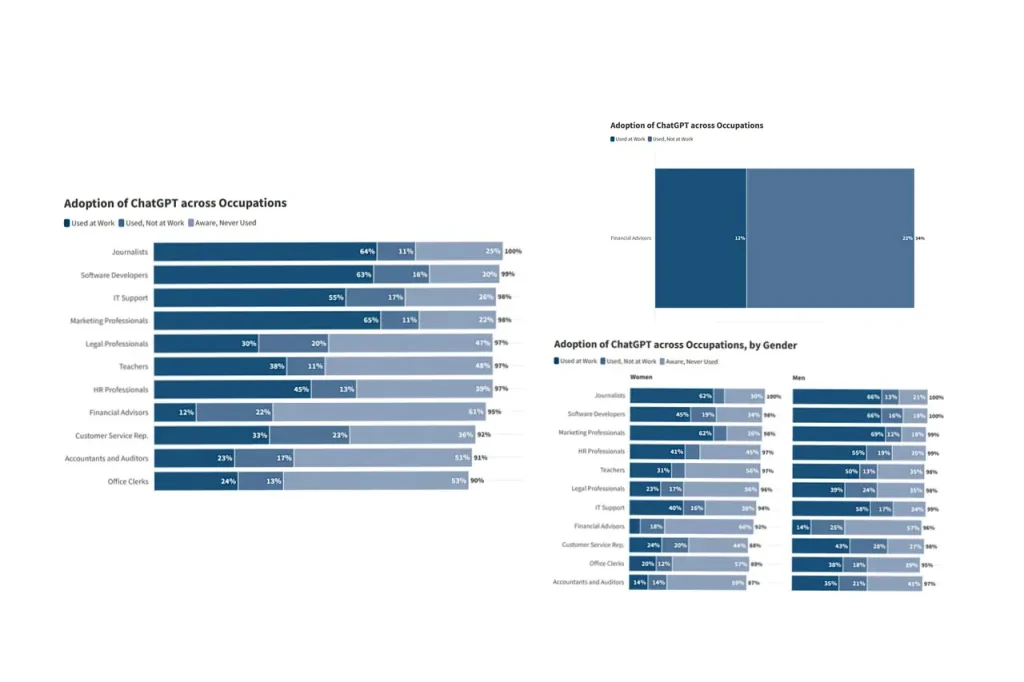
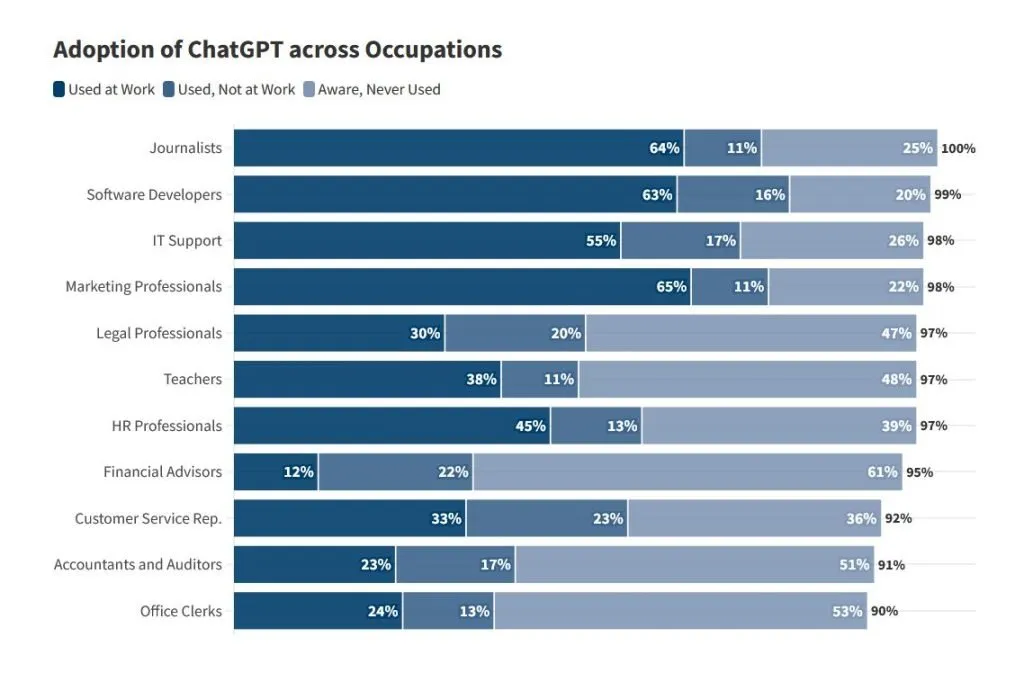
- Adoption rates range from 79% among software developers to 34% among financial advisors.
- Nearly all employees in affected occupations are aware of ChatGPT.
- Currently, 32% of employees are using ChatGPT, with 6% holding a Plus subscription.
- Younger and Less Experienced Employees More Likely to Use ChatGPT:
- For each additional year of age or experience, the likelihood of using ChatGPT decreases by approximately 1 percentage point.
- Higher Pre-Existing Income Level:
- Employees using ChatGPT had slightly above-average income levels prior to its introduction.
- Significant Gender Gap:
- Female employees are 20 percentage points less likely to use ChatGPT compared to their male counterparts in the same profession.
- This gender gap persists even among colleagues in the same workplace and cannot be explained by specific task combinations.
- Perceived Productivity Gains:
- Employees believe that ChatGPT significantly enhances productivity, especially for those with less experience.
- Limited Effect of Information Interventions:
- Providing expert evaluations on time savings from ChatGPT did change employee perceptions.
- However, this intervention had a limited impact on actual adoption rates.
- Adoption Barriers:
- Employees reported that usage limitations and the need for training are the main barriers to adoption.
- Few cited fears of dependency on technology or job redundancy as reasons for not using ChatGPT.
Implications of the Research
The findings suggest that businesses could play a crucial role in promoting further adoption of tools like ChatGPT. Proactive measures from companies or governments to encourage adoption may help address some concerning trends highlighted in the study.
For instance, the fact that current users had higher incomes before ChatGPT’s emergence indicates that less experienced employees may require additional support to benefit from generative AI. Similarly, providing more training for women could help reduce the gender gap identified in the research.
Lastly, while many employees reported that they would not increase output in tasks where ChatGPT enhances productivity, as organizations restructure workflows around tools like ChatGPT, these productivity gains may ultimately lead to greater output expansion and stimulate economic growth.
Source: https://bfi.uchicago.edu/wp-content/uploads/2024/04/The-Adoption-of-ChatGPT.pdf