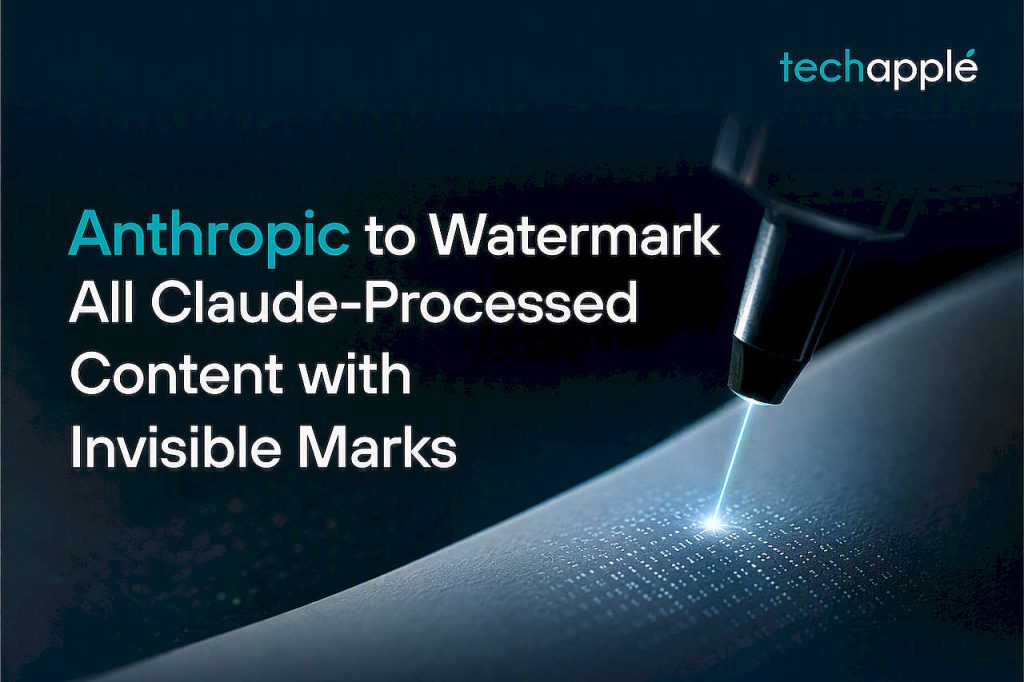
Anthropic to Watermark All Claude-Processed Content with Invisible Marks
Anthropic has announced it will soon add machine-readable watermarks to content processed by any of its models, in a move to comply with the European Union’s AI Act. The marks cover not just AI-generated output, but also human text that Claude merely edited.
- Anthropic will embed invisible watermarks in text output from all new models, globally
- The move complies with the EU AI Act, which applies to models released after August 2
- Watermarks cover all content processed by Claude, including light edits to human writing
- A text detection API is planned; penalties reach up to 15 million euros or 3% of global annual revenue
How the Watermark Works
In a support article, Anthropic explained that it is rolling out machine-readable watermarks to comply with the European Union’s AI Act, which requires all AI system providers to watermark AI-generated or manipulated audio, image, text, and video outputs. The law applies to any AI model released after August 2, with a grace period until December 2026 for providers to update previously released models.
Anthropic confirmed that all new models offered globally will mark AI-generated content from day one. Text outputs will carry embedded watermarks that are invisible to the user, while other generated files will include digitally signed provenance metadata where supported. For non-text content, Anthropic will use the C2PA metadata approach.
Coverage Beyond the Legal Requirement
Anthropic’s approach goes further than the regulation requires. EU guidance explicitly exempts cases where an AI system performs an assistive function for standard editing, such as grammar correction, or where it does not substantially alter the user’s text. But a watermark applied at the model level cannot tell wholesale generation from a comma fix, so Claude may end up marking content the law was written to leave alone.
The company acknowledged the situation: people often use Claude to proofread, translate, summarize, or convert files, and the output can carry a Claude mark even if the underlying ideas, text, or data originated from another source.
Easy to Bypass, Easy to Misunderstand
Text watermarks work by biasing the model’s word choices in a pattern spread across the document, detectable only in aggregate by the right tool. Anthropic noted the marks will travel with the text when copied and pasted, and may persist through some editing. But pasting watermarked text into another chatbot system that edits it could destroy the mark. For images and video, screenshots or standard metadata editing tools can remove the information.
The signal is also not conclusive. Anthropic said a detected mark provides a signal that content was processed by Claude but is not fully conclusive, and the mark may even appear on content not generated by Claude. A lack of a detected mark does not mean the content was not AI-generated or processed.
Detection Tool and Penalties
Anthropic plans to ship a text detection API so users can identify marks themselves. Under the EU AI Act, violations can draw fines of up to 15 million euros, or 3 percent of a company’s worldwide annual revenue.
Source: Ars Technica