
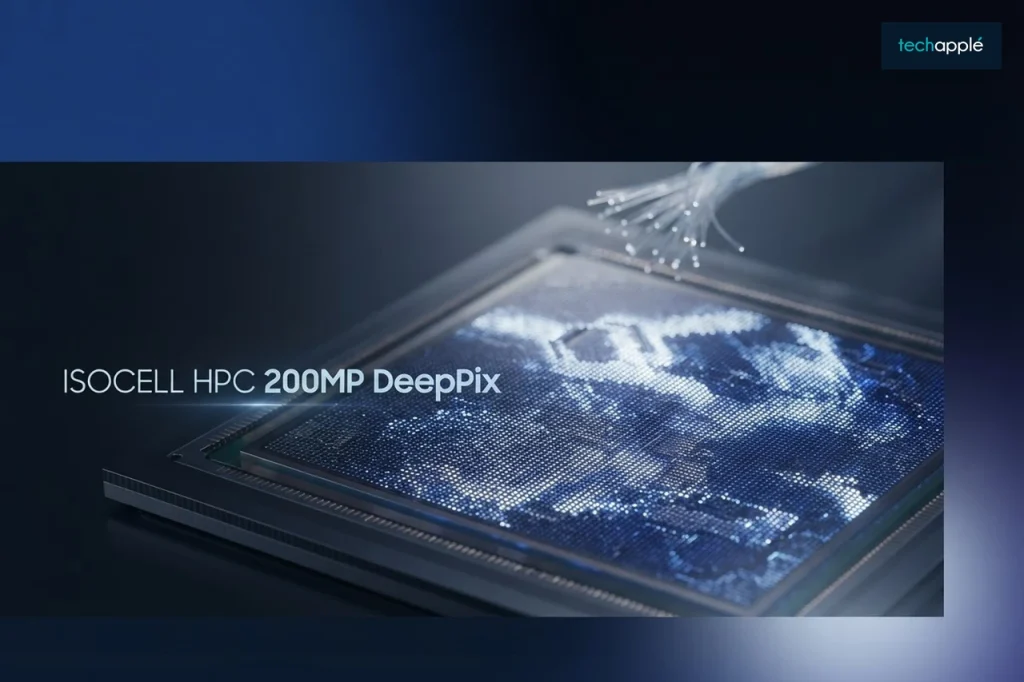
What’s Next for 200MP Phone Sensors? Samsung’s ISOCELL HPC and DeepPix Explained
Samsung unveiled the ISOCELL HPC, a 200MP mobile image sensor, on August 7, introducing its DeepPix pixel technology for the first time to improve light capture and dynamic range without enlarging the pixels. It is one of the few fresh developments in the phone camera sensor space in recent months.
- The ISOCELL HPC is a 1/1.3-inch 200MP sensor with a 16,384 x 12,288 effective resolution and 0.6 um pixels
- It debuts the DeepPix pixel architecture with dual vertical transfer gates and a shared floating diffusion structure
- Official specs list RAW10, RAW12, RAW14 and RAW16 output formats
- The sensor is rumored for the Galaxy S27 Ultra, though Samsung has not confirmed any device
What Is the ISOCELL HPC
The ISOCELL HPC is Samsung’s newest 200MP mobile image sensor, built to combine ultra-high resolution with strong HDR performance. Samsung says the sensor builds on the ISOCELL line’s 200MP imaging heritage and that its first-ever DeepPix technology redefines how light is captured, targeting richer HDR, lifelike colors and optimized image quality at every zoom level for ultra-high-resolution mobile imaging.
How DeepPix Improves Light Capture
DeepPix is a new pixel architecture focused on improving charge handling efficiency at the pixel level without increasing pixel size. Samsung explains that DeepPix improves photodiode (PD) potential, enables more efficient charge transfer through dual vertical transfer gates (D-VTG), and increases floating diffusion (FD) capacitance through a shared FD structure. Together these enhancements strengthen Samsung’s FDTI isolation technology, enabling higher imaging performance while keeping the pixel size unchanged.
Specs at a Glance
Official specs list an effective resolution of 16,384 x 12,288 (200MP), a 0.6 um pixel size and a 1/1.3-inch optical format. For stills, the sensor reaches 7.5 fps at full resolution, 30 fps at 50MP and 180 fps at 12.5MP. Video modes include 8K at 30 fps, 4K at 180 fps and FHD at 360 fps without autofocus. The color filter uses a Tetra-squared-pixel RGB Bayer pattern, autofocus is Super QPD (PDAF), and the sensor supports 4K at 120 fps with all-pixel PDAF.
Dynamic Range and Output Formats
HDR is handled by Smart-ISO Pro (iDCG) and DSG technologies, and the output formats include RAW10, RAW12, RAW14 and RAW16, meaning 16-bit RAW capture is supported. Analog gain reaches 16x at full resolution and 160x in 12.5MP mode. The interface offers 4-lane D-PHY (2.5 Gbps per lane) or 3-trio C-PHY (5.0 Gsps per trio).
Rumor: Will the Galaxy S27 Ultra Use It
Observers widely expect the ISOCELL HPC to appear in the Galaxy S27 Ultra early next year, but Samsung has not confirmed this. The company only announced the sensor itself and has not named any device, so the S27 Ultra connection remains speculation for now.
FAQ
How is DeepPix different from regular pixel technology?
DeepPix improves charge handling through dual vertical transfer gates and a shared floating diffusion structure, boosting light capture and dynamic range without enlarging the pixel.
How does the 200MP output work?
The sensor outputs 16,384 x 12,288 pixels via a Tetra-squared-pixel RGB Bayer pattern, with 50MP and 12.5MP binning modes at different frame rates.
Which phone will use the ISOCELL HPC first?
Samsung has not named a device. Rumors point to the Galaxy S27 Ultra, but nothing is official yet.
Source: Samsung Semiconductor
Cover image generated by AI for illustrative purposes only.