Kimi K3.1 Pro : A 3T-Parameter Model with 1M Context
Moonshot AI has published the official documentation and quickstart guide for Kimi K3.1 Pro on its developer platform. According to the official summary, K3.1 Pro is the first model of the K3.1 series and the team’s most capable to date at the 3-trillion-parameter scale, supporting 1 million tokens of context, with particularly notable gains in coding, 3D creation, financial research and other long-horizon agent capabilities. A high-speed variant, Kimi K3.1 Pro Highspeed, offers roughly 2-3x output speed at the same intelligence level, and the full model weights will be released by November 4.
- 3-trillion-parameter scale, 1M context; Highspeed variant outputs 2-3x faster
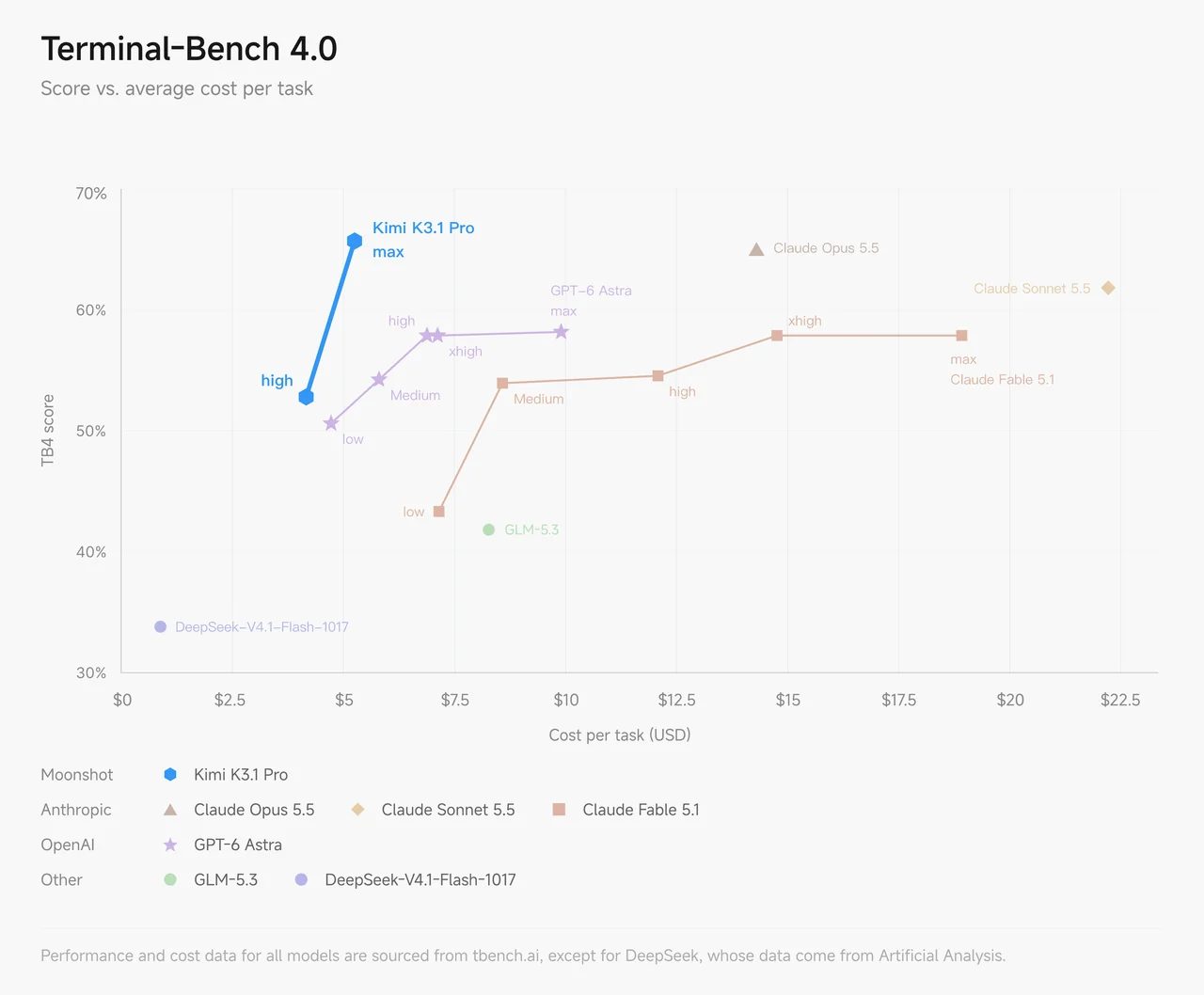
- Terminal-Bench 4.0 score of 65.7%, above GPT-6 Astra and close to Claude Opus 5.5
- Best results on both Office QA Pro v2 and SpreadsheetBench 2
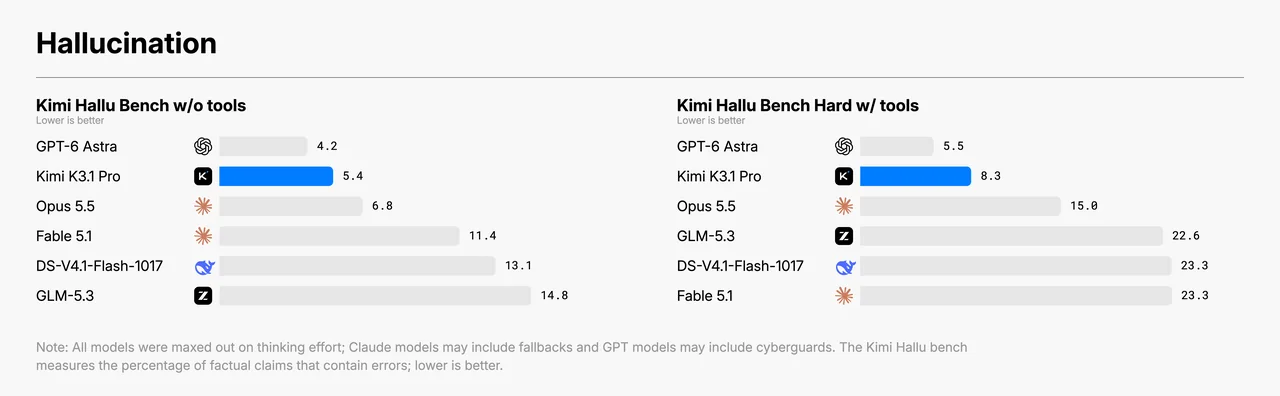
- Factual statement error rate cut from 23.35% to 6.85% (stress-test basis)
- Cyber-offense data identified and removed from training, with explicit open-weights safety principles
- Weights due before November 4; platform unlocks with a minimum top-up of 10 yuan
Coding and 3D: terminal tasks close the gap with closed flagship models
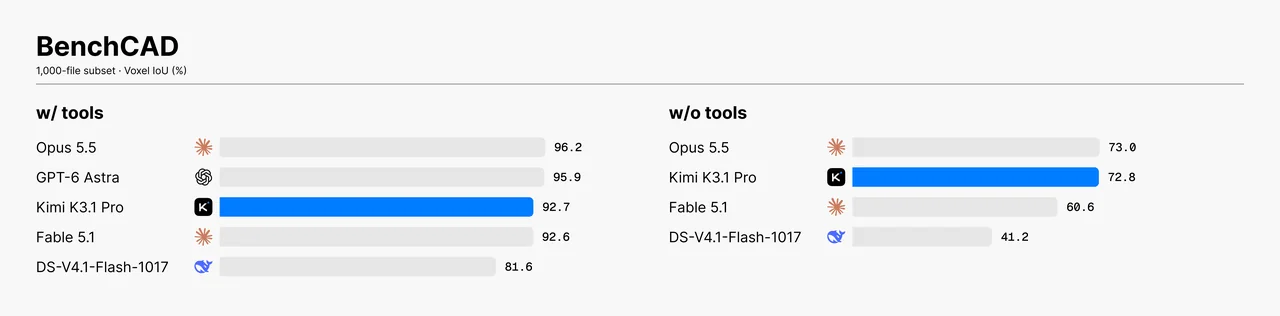
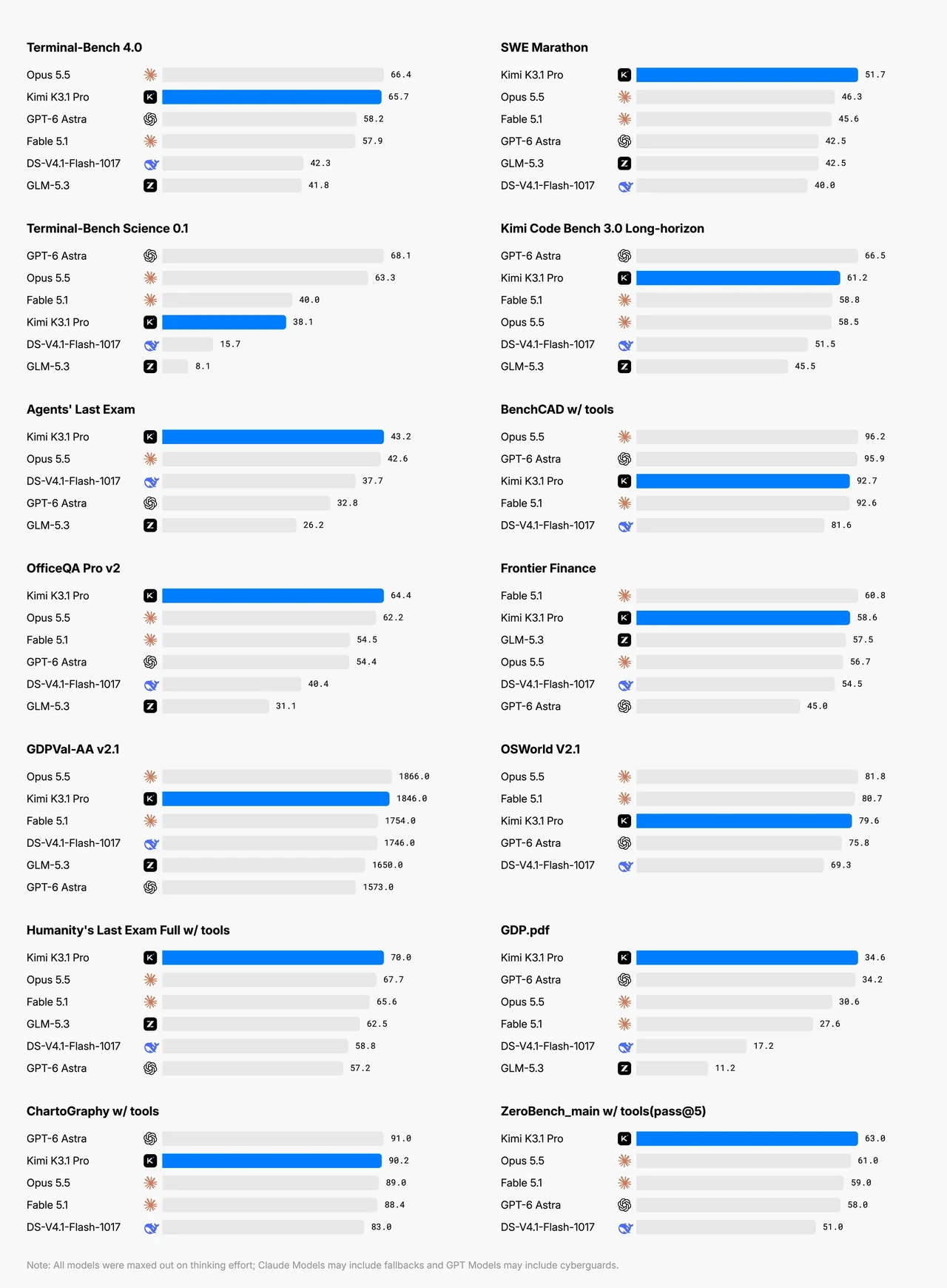
On coding, the documentation highlights two headline results: Terminal-Bench 4.0, which evaluates coding agents on resource-constrained terminal tasks in real environments, saw K3.1 Pro score 65.7%, above GPT-6 Astra’s 58.2% and only marginally behind Claude Opus 5.5 at 66.4%. The internal Kimi Code Bench 3.0 Long-horizon returned 61.2%, up from K3’s 55.95%. 3D creation is a focus of this generation: given a text description, a sketch or a reference image, the model infers shape, proportion and spatial relationships to rebuild usable 3D models, and can write and run scripts for professional modeling tools such as Blender, SolidWorks and Rhino without relying on MCP connectors, handling parametric modeling tasks like mechanical parts, architectural models and configurable products, with results fed into Three.js scenes or game engines. It is also described as proficient with Unity, Unreal Engine and Godot.
Finance: accuracy and workflows together
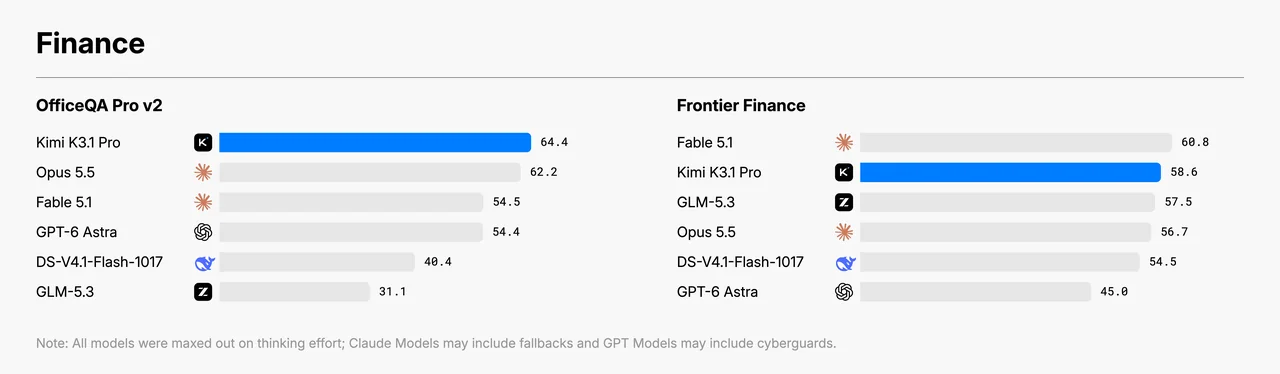
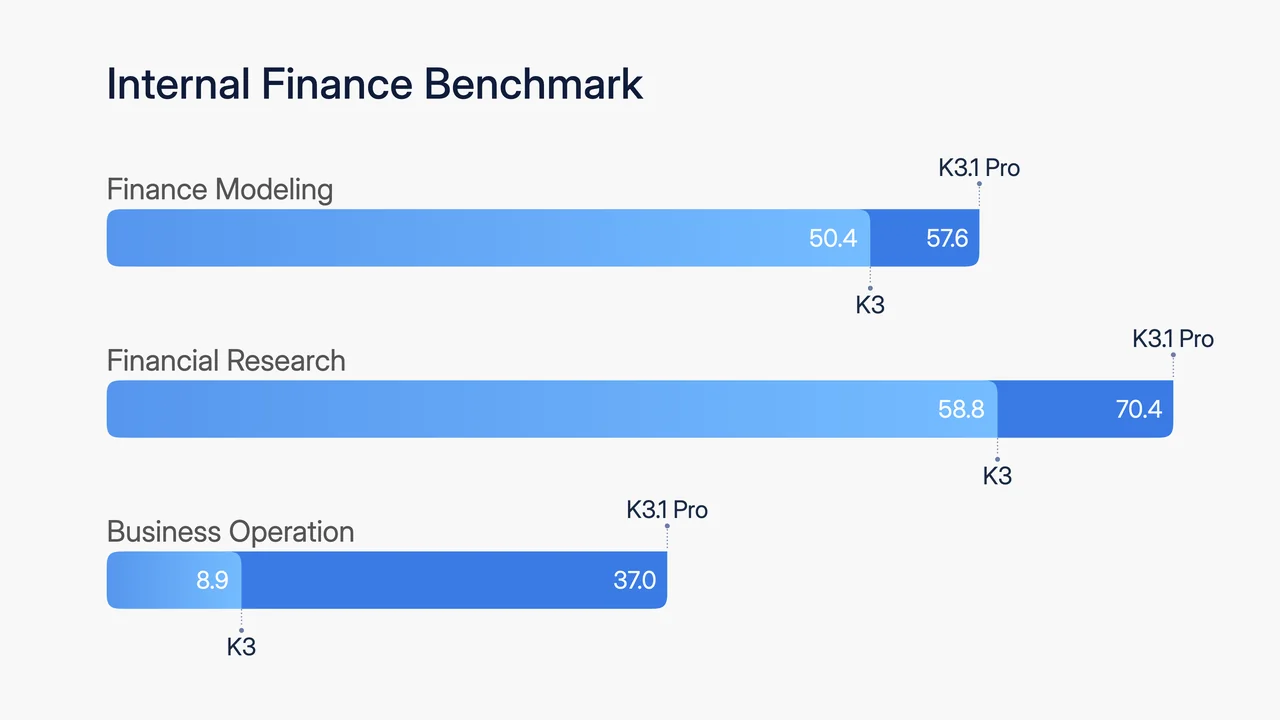
Finance receives the most attention in the documentation. K3.1 Pro posts the best results on both Office QA Pro v2 and SpreadsheetBench 2, beating Opus 5.5, Fable 5.1 and GPT-6 Astra on each, and improves over K3 on Frontier Finance, which measures an end-to-end investment workflow. Because financial research demands factual precision, the team ran a dedicated optimization: in a de-identified set of conversations where users had flagged factual errors, the per-statement factual error rate fell from 23.35% with K3 to 6.85%, and the share of responses containing at least one factual error was only about 46.4% of the previous generation’s. Three internal benchmarks also show comprehensive gains over K3: Financial Modelling up 14%, Financial Research up 20%, and a score of 37.0 on the long-horizon Business Operation benchmark, about 4.2 times K3’s.
Cyber-offense capability: training data proactively removed
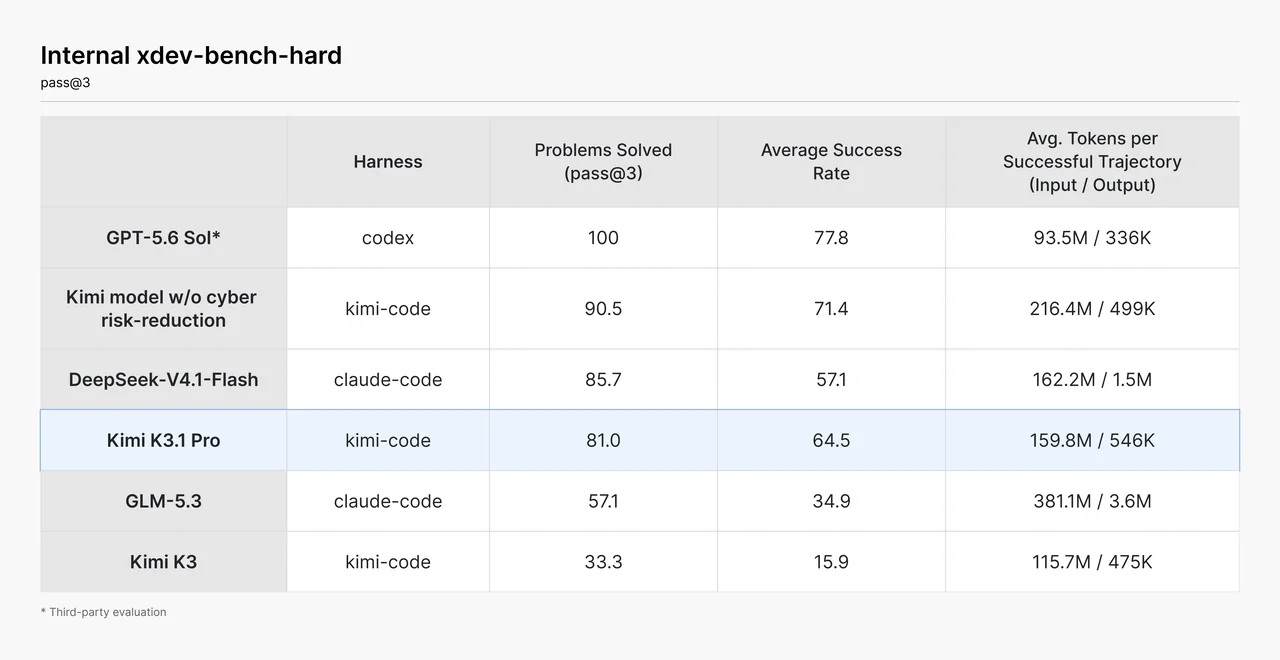
The documentation is unusually candid on safety. The team observed that as post-training scale grew, the model’s vulnerability-research performance kept improving, and traced this to cyber-offense content embedded in the mid-training corpus and to such tasks present in the reinforcement learning environment mix. In response, the official process identified and removed cyber-offense-related data from both training stages while retaining the general coding tasks needed for usability. On xdev-bench-hard, an in-house benchmark that reproduces recently disclosed vulnerabilities in the Linux kernel, Node.js, JavaScriptCore, Exim and VirGL from source code and measures pass@3, the model solved 90.5% of tasks when the data was left in, versus 81.0% for the final K3.1 Pro. The company says the removal demonstrably lowered offensive capability and commits that open-weights releases will not push the absolute frontier of cyber-offense capability, arguing that open weights better serve defensive, dual-use research needs.
Quickstart and important limits
Developers can try the model in the Playground or apply for an API key; the API is OpenAI SDK compatible with a base_url of api.moonshot.cn/v1, and the model IDs are kimi-k3.1-pro and the high-speed kimi-k3.1-pro-highspeed. Limits worth noting: K3.1 Pro always has thinking mode on, with only the top-level reasoning_effort setting (low/high/max, default max) controlling reasoning intensity; sampling parameters such as temperature and top_p are fixed and should not be passed explicitly; multi-turn conversations and tool calls must return the full assistant message verbatim; vision input does not accept public image URLs and requires base64 or an ms:// file ID with array-form content; and the web search tool is being updated and not recommended for production use for now. Billing is usage-based across the full 1M-token context with no length tiers, covering cache writes (5-minute and 1-hour TTLs), input (cache hit and miss) and output. A minimum top-up of 10 yuan unlocks the model, the 15-yuan voucher given to newly verified users does not apply, and cumulative top-ups determine account tier and rate limits.