Pipescan AI Uses Robotics and AI to Protect Confined-Space Safety【Hong Kong ICT Awards 2025: Startup Award】
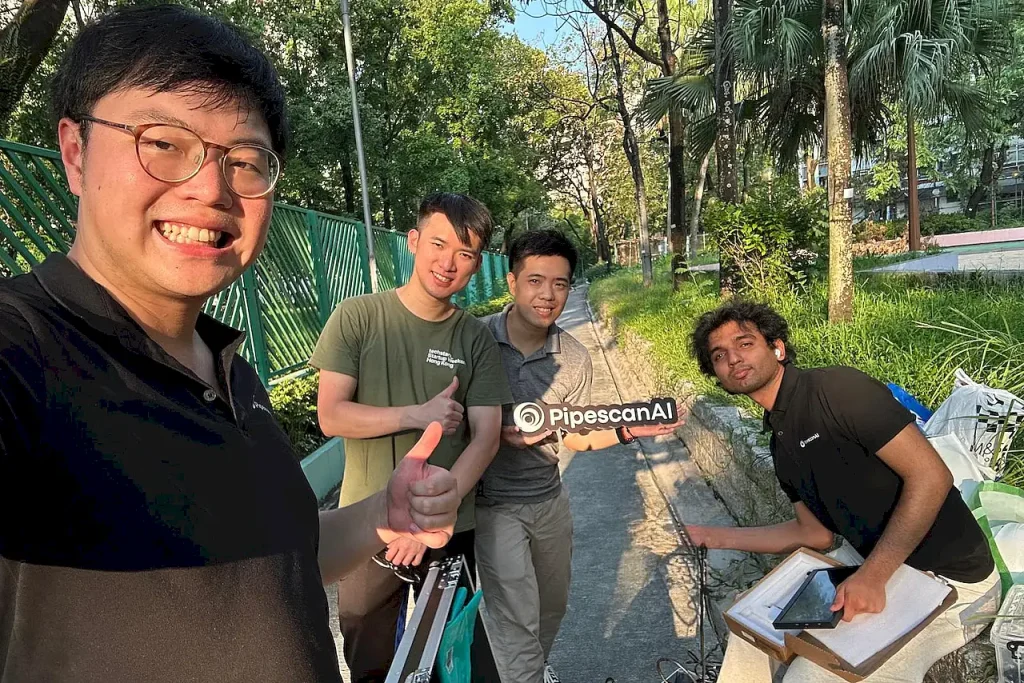
In recent years, Hong Kong has seen multiple industrial accidents involving confined spaces, drawing widespread public attention to site safety. As a result, replacing human entry into high-risk environments with technology has become an urgent priority for the industry. Pipescan AI—winner of the “Best Software and Apps (Certificate of Merit)” at the Hong Kong ICT Awards (HK ICT Awards) this year—has built a 3D scanning and defect-detection platform that provides a robust safety safeguard for underground infrastructure inspections.
“We are truly honoured to have been selected for this award. Receiving the Certificate of Merit in the Software and Apps category is both a proud moment for our team and a meaningful recognition of our mission to enhance safety through technology.”
Tackling the core pain point: machines instead of people
Pipescan AI is a 3D scanning and defect-detection platform purpose-built for confined spaces. Its core value lies in combining advanced robotics with AI-driven analysis, enabling engineers to carry out high-precision inspections without physically entering hazardous environments.
Key features and advantages include:
- Safety first: Eliminates the need for workers to operate in confined spaces with risks such as methane build-up or structural instability (e.g., drainage pipelines).
- Higher data accuracy: Compared with traditional visual checks, AI can capture and identify subtle defects more reliably.
- Cost and efficiency gains: Significantly speeds up inspections while reducing insurance and labour costs.
The product currently serves customers such as government departments, utilities, and infrastructure contractors responsible for drainage networks and underground pipelines.
R&D motivation: built to save lives
Lentz said the project was driven by deep concern over the frequent confined-space accidents in Hong Kong in recent years: “We saw an urgent market need for a reliable technological alternative.”
However, delivering automated inspection in complex underground environments is far from straightforward, and the team faced two major technical challenges during development
- Navigation in harsh environments: Ensuring robots can navigate accurately and capture data in dark, wet, and structurally complex pipelines.
- AI model robustness: Building AI models strong enough to detect a wide range of subtle and hard-to-spot structural defects with high accuracy.
“Combining engineering expertise with frontier technology is a tough task,” Lentz noted, “but it has strengthened our belief that this solution can truly save lives.”
What’s next: Southeast Asia and the Middle East
Looking ahead, Pipescan AI is targeting opportunities in Southeast Asia and the Middle East. Lentz pointed to rising flood risks in recent years and ageing underground infrastructure in these regions as drivers of strong demand for safe, efficient inspection tools.
The team believes Pipescan AI can deliver measurable value and become a preferred alternative to conventional inspection methods, while continuing to enhance AI analytics, automation, and deeper integrations with asset-management systems.
